
Monitoring Killer Whale Body Condition and Predicting Calf Survival
By Holly Fearnbach, Marine Mammal Research Director
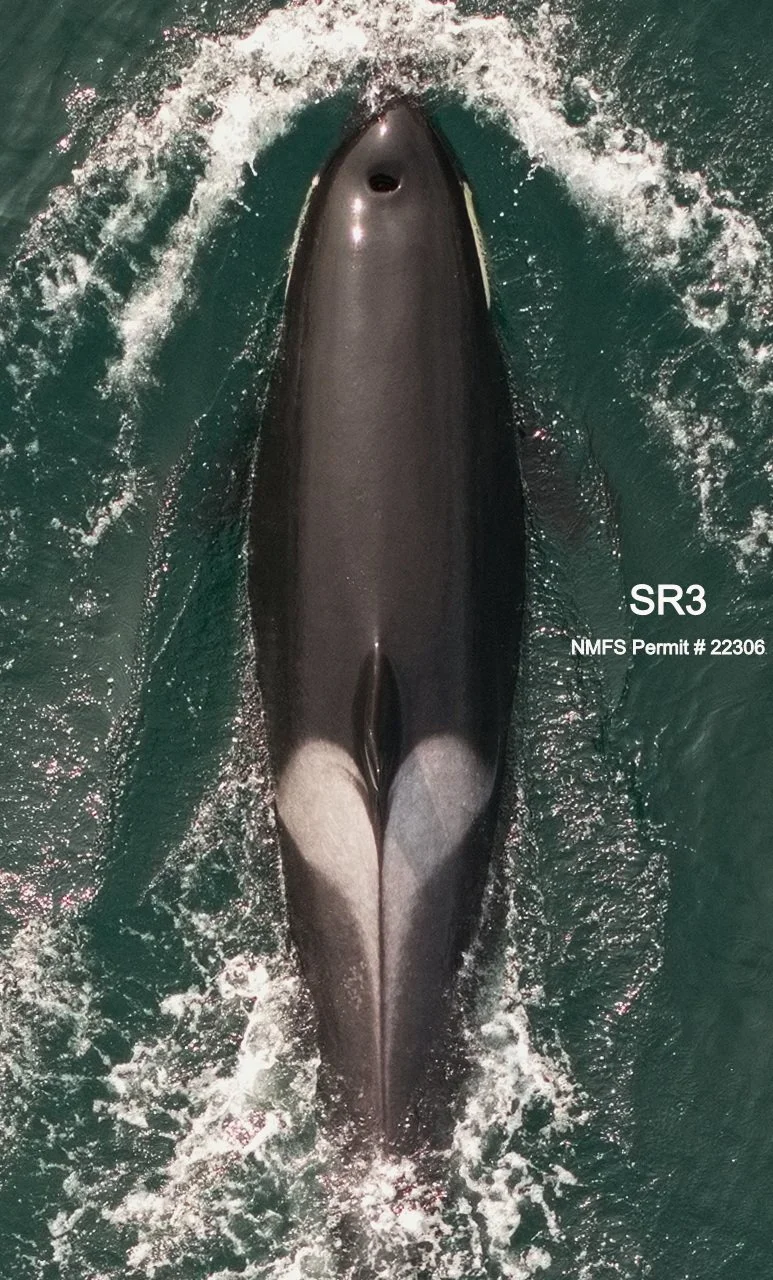
Aerial image of K36 in 2025 collected non-invasively using a remotely operated octocopter drone. Research conducted under NMFS Research Permit # 22306.
A calf, K47, was recently born into K pod of the endangered Southern Resident killer whales (SRKWs). Likely the offspring of K36 (to be confirmed by colleagues at the Center for Whale Research), there is a high level of concern for the survival of this calf due to a series of newborn calf mortalities in recent years. The likelihood of newborn calf survival greatly improves if its mother is in robust body condition during pregnancy, indicating that she has had an adequate supply of prey to maintain a healthy pregnancy and help buffer the demanding costs of nursing.
The research team at SR3 uses drones to non-invasively monitor the health of SRKWs throughout the year. We analyze aerial images taken with the drones to provide measurements of both individual and population health, assessing nutritional and reproductive status. Our most recent body condition measurements of K36 show that she was indeed in robust condition, a promising sign.
Here are examples of body condition measurements of SRKWs since 2015 (shown with gray lines), highlighting two SRKW females: L90 and K36 (shown with black lines). The red dashed horizontal line indicates “normal” body condition. Body condition lines that fall above the dashed line show whales that are in “above normal” and “robust” body condition, while lines that fall below the line show whales in “sub-normal” and “poor” body condition. The top graph shows body condition measurements for L90, who gave birth in September 2024 to a calf (L128) that subsequently died. Our measurements show that she had sub-normal body condition throughout her pregnancy and leading up to the birth of L128 (shown by red star). In contrast, K36 has been measured to be in robust condition during her pregnancy and leading up to her probable birth of K47 (shown by red star). These measurements are promising for the survival of K47. We will continue to monitor the condition of K36, K47 and the rest of the SRKW population in the coming year.
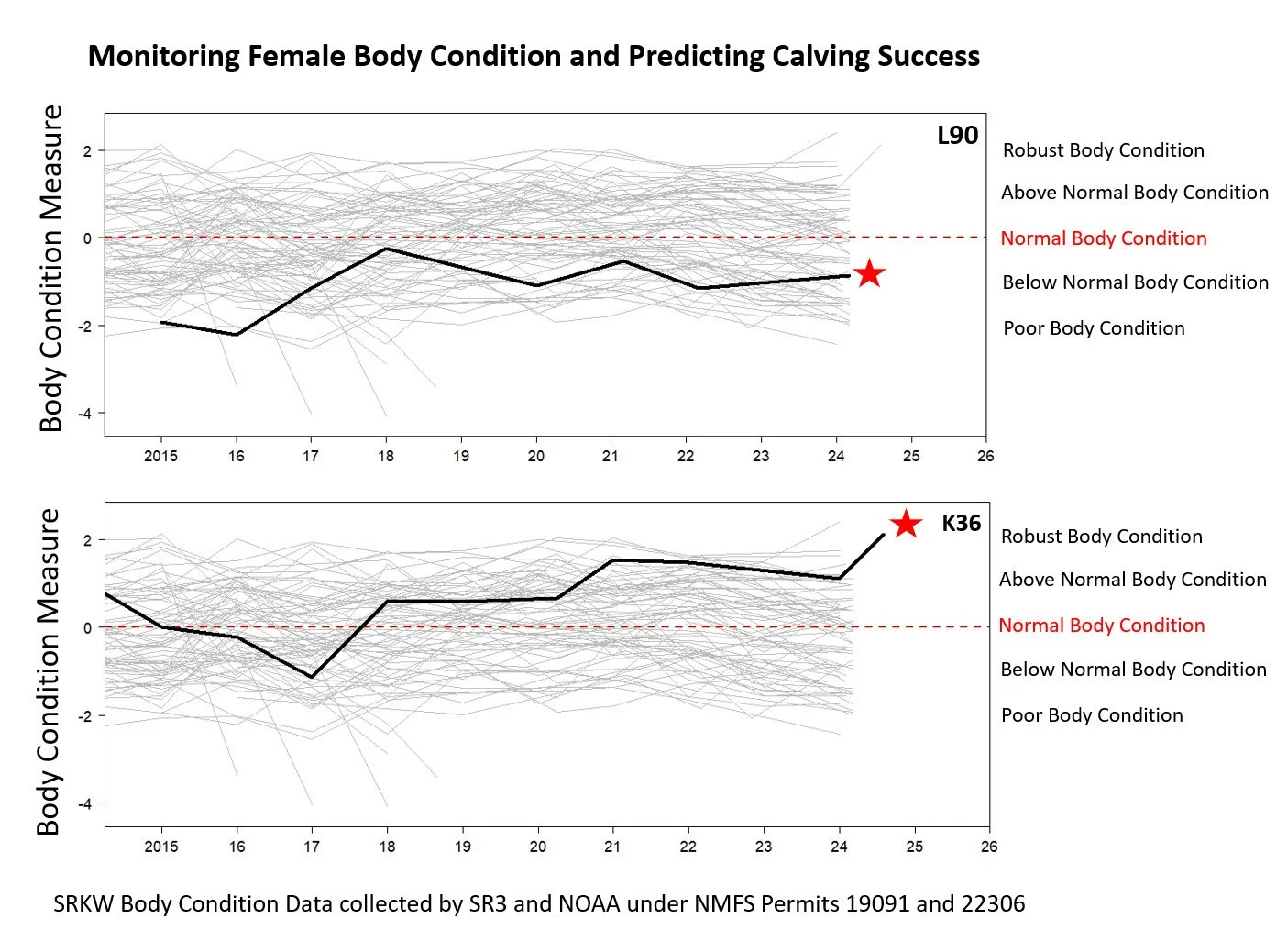
Body condition of SRKWs since 2015 (gray lines). The red dashed horizontal line indicates “normal” body condition. Body condition lines that fall above the dashed line show whales that are in “above normal” and “robust” body condition and lines that fall below the line show whales in “sub-normal” and “poor” body condition. (Top) Body condition measurements for L90, who gave birth in September 2024 to a calf that subsequently died. (Bottom) Body condition measurements for K36, leading up to her probable birth of K47. Births are represented by red stars. Body condition data collected under NMFS Permits 19091 and 22306.